Make your documents a private, citable source of knowledge for your AI
AiGrid turns the workstations and servers you already own into a private processing grid that reads, OCRs, and indexes your document archive inside your network, with no GPU required.
At cloud list prices, converting a 200 million page archive costs about $2 million. On AiGrid, with 2,000 workstations and 30 servers lending capacity, it is $78,845 a year. See the comparison
From $19,995 per year, with no per-user or per-page fees.
Workstations and clusters are both taking work.
“In effect, a distributed virtual AI supercomputer.”
How one CIO described AiGrid to his peers. The grid is built for one job: converting your documents for retrieval.
Your AI assistants can only work with what they can read
Most organizations hold decades of contracts, reports, manuals, and scanned archives that no AI assistant can use until every page has been read, laid out, OCR'd, and indexed, and that processing is heavy compute.
You can send the documents to a cloud service, which is hard to accept for sensitive material and is billed by the seat, the page, or the query. Or you can buy GPU infrastructure and run the pipeline privately, which is expensive, slow to procure, and becomes a permanent workload for your team.
There is a third source of compute, and you have already paid for it.
The capacity is already on your balance sheet
AiGrid groups the machines you lend into pools, and an administrator sets the schedule for each one. The agent runs at low priority, so it does not compete with other work.
After hours
The desktops your staff leave at night
Hundreds or thousands of workstations sit idle every evening. AiGrid uses them overnight and hands them back before the working day starts, and each one follows its own local clock.
A workstation converts about 13 pages a minute. A pool of 1,000 working a 12-hour night converts about 9 million pages before the working day starts.
Default hours for a workstation pool: weekday evenings and overnight.
Around the clock
The servers waiting for a bad day
Standby capacity in a DR site can do useful work on every other day. A server pool can run all day, every day, or on whatever schedule you choose.
A server pool can be set to work around the clock.
Spare capacity only
The headroom in the clusters you run
On a cluster, AiGrid runs below every other workload. It scales up from zero when there is work and gives the capacity back the moment the cluster needs it.
Illustration. What a cluster lends depends on what it has spare at that moment.
Built on compute you already own
There are dozens of cloud RAG services, and dozens of RAG engines that need a GPU fleet. We could not find one that uses the compute an enterprise already owns, so we built it. AiGrid does the heavy document conversion on ordinary CPUs across your workstations, DR servers, and clusters, so there is no GPU to procure and no per-page cloud bill.
- Private by architecture
- There is no AiGrid cloud service for your data to go to. The documents, the extracted text, the index, and the models all stay in your environment, and the appliance only ever has read access to your document store.
- It retrieves and never generates
- Every result is a real passage from your own documents with its filename and page number. Your assistant writes the answer and cites the source, so people can check what they are told.
- It fits the AI stack you have
- AiGrid serves retrieval through an HTTPS search API, so you connect your organization's LLM platform to it and every assistant behind that platform can use it. You can use your own vector database in place of the built-in one, or keep your whole RAG layer and use AiGrid purely for text extraction.
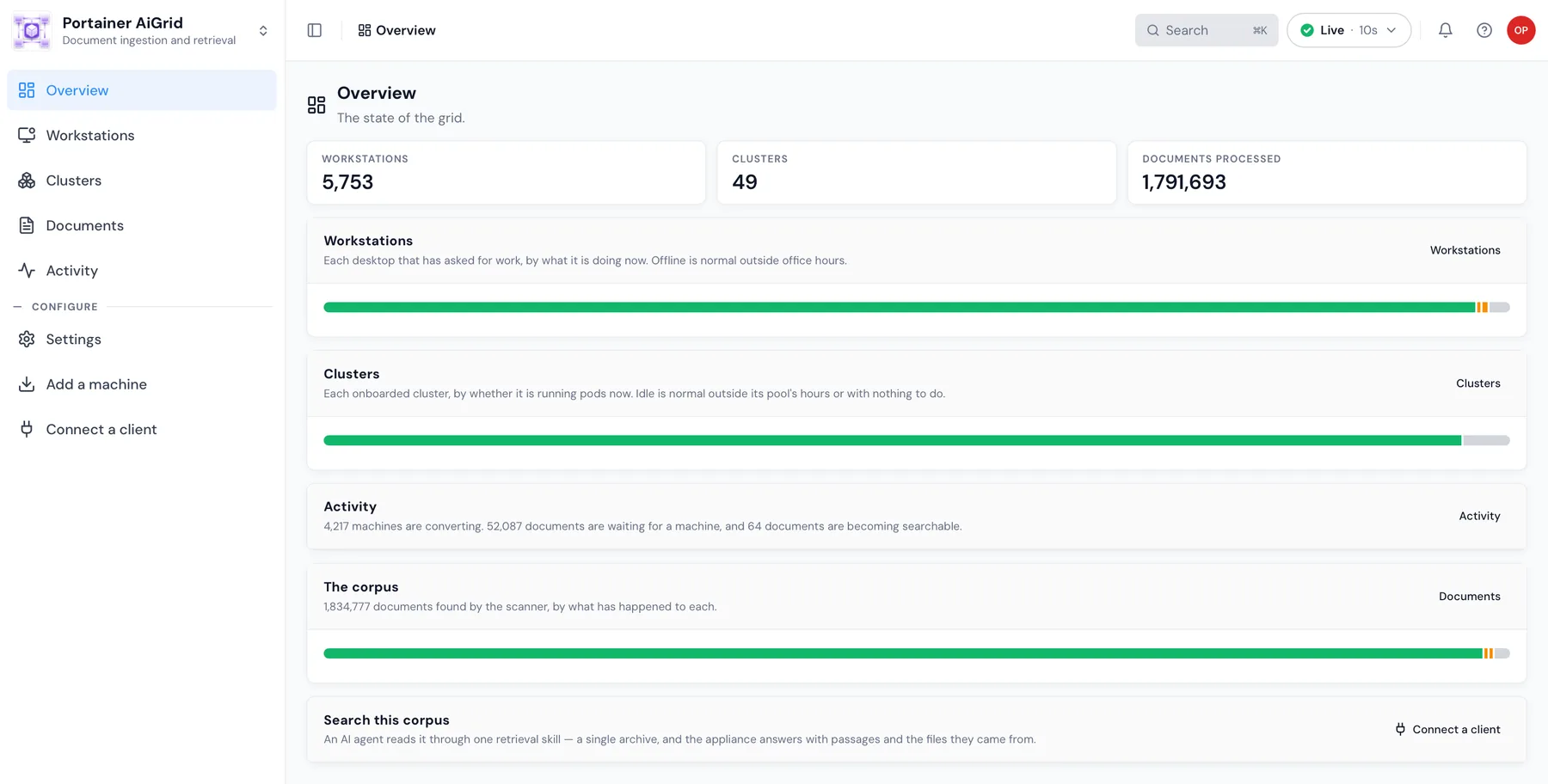
One dashboard for the whole grid
Operators see every workstation, cluster, and document on one screen, and switch work on or off for the whole fleet or for a single pool.
Built for the questions your CISO will ask
- Machines in a pool never receive an inbound connection. Every call is outbound HTTPS.
- On a desktop the agent runs under its own service account, at low priority, and not as the user.
- Air-gapped capable. Processing and search call no external service.
What your people see
They ask your AI assistant a question in plain language, and the answer comes back with the documents and pages it rests on.
Question
What notice period applies if we terminate the supply agreement?
Your assistant
Either party may terminate with 90 days' written notice. Termination for an unremedied breach takes effect after 30 days.
- supply-agreement-2014.pdf page 17
- supply-agreement-amendment-2.pdf page 3
From document store to cited answer
Your documents stay where they are
AiGrid scans your S3-compatible storage on a schedule and queues anything new or changed.
Machines ask for work
A machine inside its allowed hours asks the appliance for a document. Work is never pushed to a machine.
The pool does the heavy lifting
The machine works out the layout, OCRs scanned pages, and cuts the text into short passages.
The appliance builds the index
Passages are indexed centrally, inside your network, alongside their filename and page number.
Your assistant asks and cites
The assistant sends a question to the retrieval endpoint, gets the best-matching passages, and answers with sources.
See it index a real corpus
We will walk you through AiGrid ingesting documents across a live pool, and show an AI assistant answering with filename and page citations.
- A live demonstration, followed by your questions.
- A trial scoped to your estate, run on your infrastructure.
- No obligation. A specialist will contact you to arrange a time.